Agent Case Workspace
Mobile-first, agent-centric case management with human-in-the-loop AI
Project Type: Concept + Interaction Design (Personal / Portfolio)
Role: UX / Product Designer
Platform: Mobile-first (responsive)
Focus: Agent-facing, record-centric workflow with LLM-assisted intelligence
Industries: Finance, Healthcare Admin, Tech, Legal, GovTech (adaptable)
Problem: Most enterprise support tools are designed around dashboards and metrics, not how agents actually work.
Background & Motivation
This project grew out of my experience designing process engineering automation tools and dashboards at IntelliFlux, along with prior exposure to CRM-style enterprise interfaces.
Across these systems, I kept seeing the same pattern: tools optimized for reporting and automation, not for the human operators doing the actual work.
Agents, analysts, and support teams weren’t lacking data. They were lacking context, clarity, and decision support at the moment of action.
This case study explores what happens when we redesign support tooling around agent cognition, not dashboards.
Dashboards dominate the experience, even though agents rarely work from dashboards. Context is fragmented across tabs, timelines, and notes. AI shows up as chatbots or black boxes, raising trust and compliance concerns. Mobile experiences are secondary, despite agents working in time-sensitive situations. In regulated environments, these issues become risk multipliers.
Decisions must be explainable. Actions must be auditable. Humans must stay accountable.
So I designed:
"A mobile-first, record-centric support workspace that helps frontline agents handle sensitive, regulated cases by surfacing context, risk signals, and explainable AI guidance at the moment of work without dashboards, automation, or loss of human control."
Design Goal
Design a mobile-first, agent-facing case workspace that supports decision-making without removing control.
The system should:
Center on a single case record
Surface intelligence only when relevant
Make AI visible, explainable, and optional
Work across regulated industries without redesigning the core experience
Core Design Choice: No Dashboard
This project intentionally avoids dashboards.
Agents do not work in aggregates. They work in individual cases, under pressure, with incomplete information.
So instead of overview metrics, the product is built around a record-centric workspace where intelligence lives around the work, not above it.
Primary Screen: Case Workspace
The Case Workspace is the agent’s main environment.
At a glance, the agent can understand:
The layout prioritizes vertical flow and one-handed use. Key actions remain accessible without navigating away.
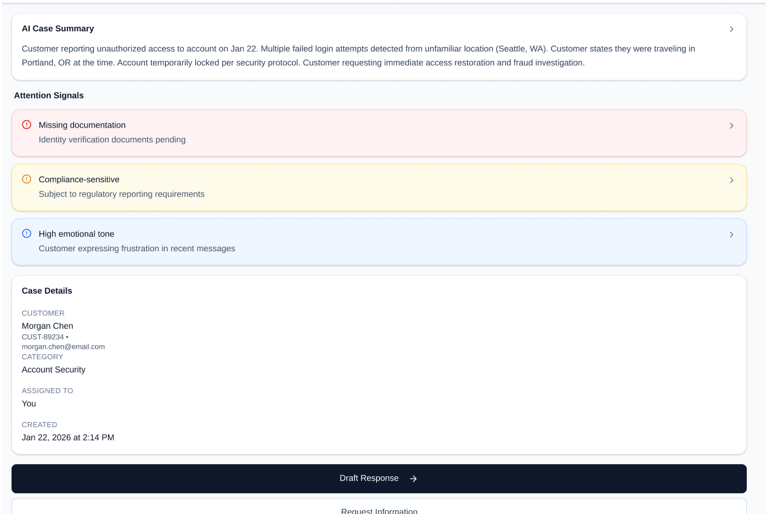
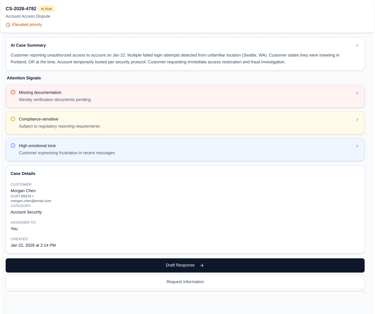
AI Case Summary highlights key events, contradictions or risks, and current state of the case. And importantly, it does not make decisions. It explains what changed and why the case matters now.


Attention Signals Instead of Scores
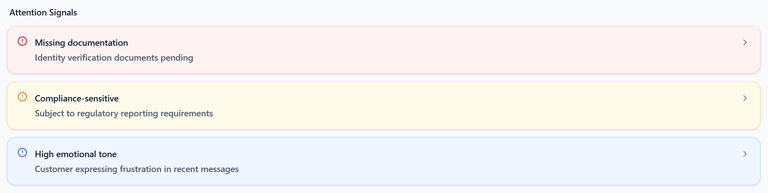
Rather than numeric risk scores, the system uses plain-language signals.
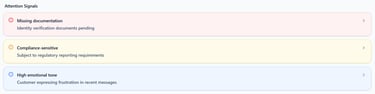
Examples include missing documentation, compliance-sensitive case, high emotional customer tone.
Each signal explains itself. Nothing is hidden behind a model output.
This approach avoids black-box AI and aligns better with regulated environments.
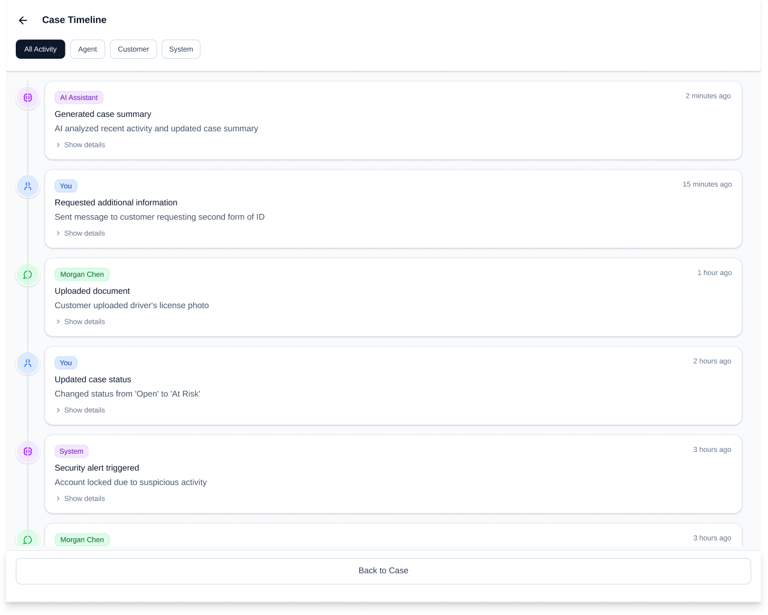
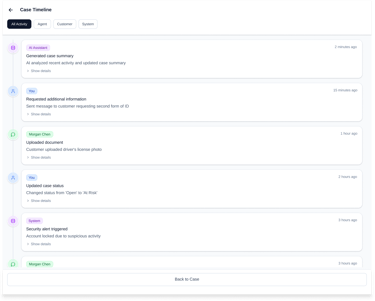
Timeline: Auditability by Default
Every case action is logged as a timeline event. Agents, customers, system rules, and AI are all visible actors. Even AI-generated summaries appear as explicit, reviewable events.
This creates a transparent audit trail without extra effort from the agent.
AI Guidance & Drafting
AI assistance appears when the agent is ready to act. It can:
Nothing is auto sent. Everything is editable.
The agent remains responsible for the outcome.
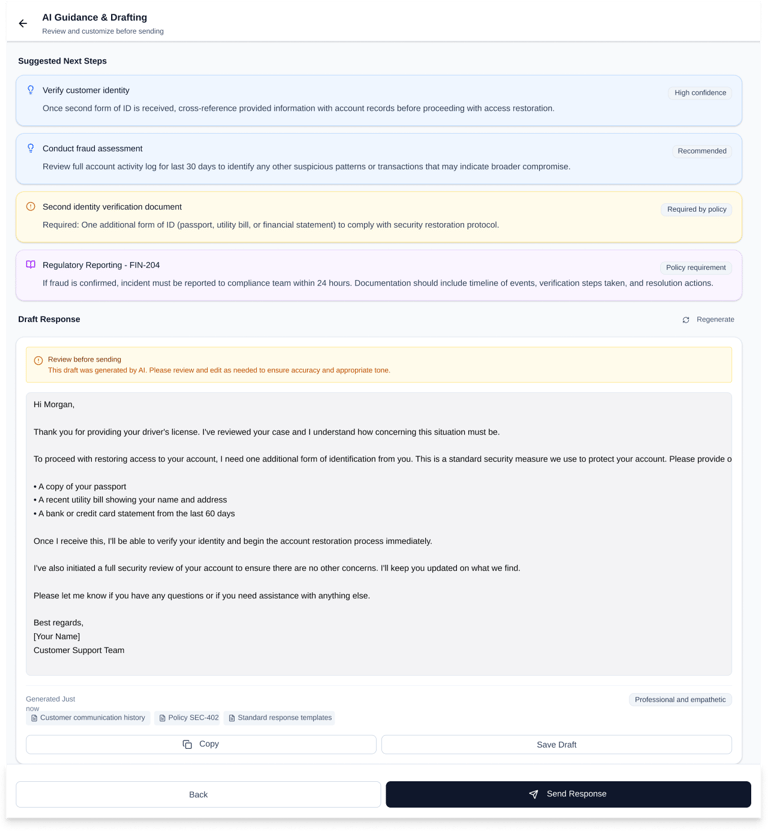
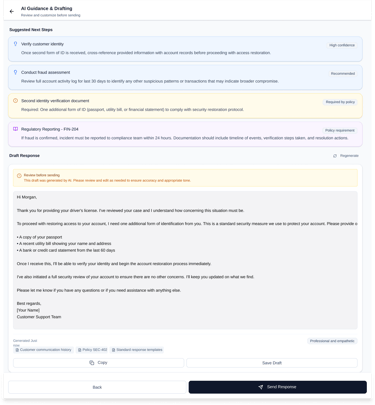
Suggest next steps
Highlight missing information
Draft responses for review
Exception and Risk States
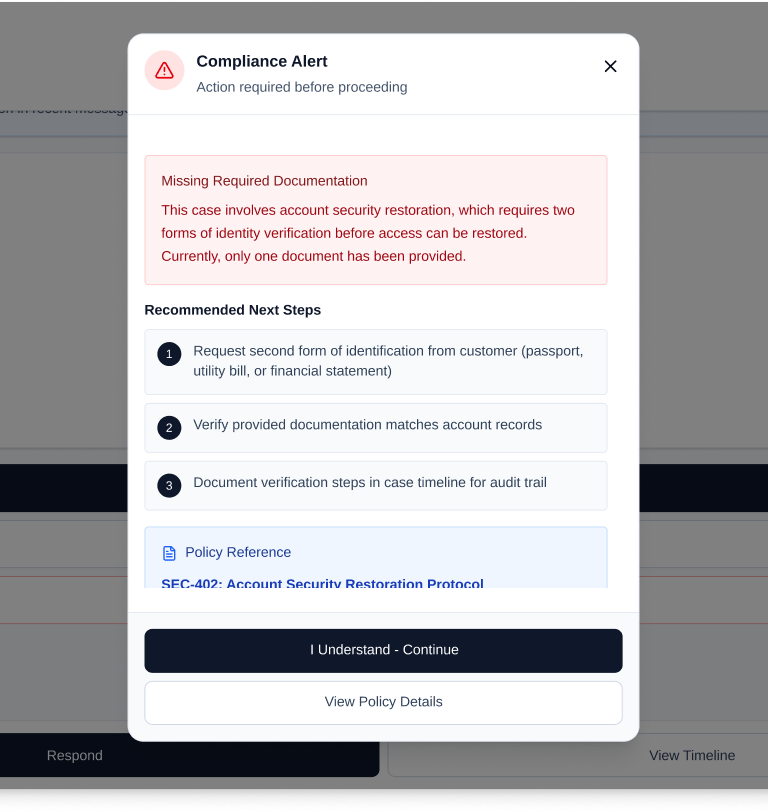
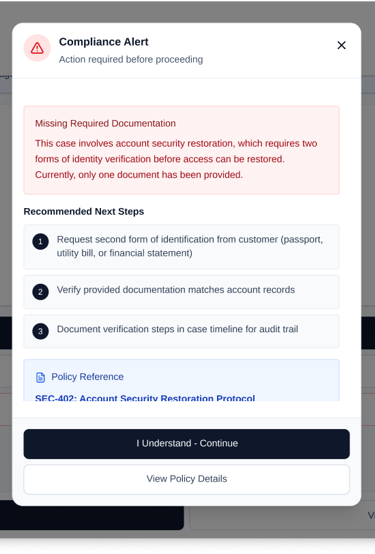
When a case crosses a compliance or risk threshold, the system interrupts clearly.
Exceptions require acknowledgment and action.
There are no silent failures and no invisible automation.
Why Mobile-First Matters
Designing mobile-first forced hard decisions:
What must be visible immediately?
What can wait?
What actions matter most under pressure?
The result is a focused experience that scales naturally to tablet and desktop without adding complexity
Industry Adaptability
The same structure supports multiple regulated domains. Only terminology, rules, and policies change. The mental model stays consistent.
This makes the system adaptable across finance, healthcare administration, legal services, and public-sector workflows.
Key Takeaways
This project demonstrates how:
Agent workflows outperform dashboards for operational work
AI can support judgment without replacing it
Transparency builds trust in regulated systems
Mobile-first design improves clarity, not just accessibility