Pipeline Validation & Leak Detection
A map-first decision tool for utility engineers
Role: UIUX Engineer, Human Factors Researcher, PM
Users: Utility engineers, operators, field teams
Platform: IntelliFlux (enterprise utility software)
Focus: Process engineering ML/AI automation tool for leak detection and pipeline validation
Industries: Chemical and process engineering
Overview
Utility engineers struggled to validate hydraulic models and detect leaks because simulation data lived in spreadsheets while real pipelines lived on maps.
I redesigned the workflow to be map-first, spatial, and task-driven, reducing manual effort and helping engineers identify anomalies faster and with more confidence.
The Problem: Pipeline networks are physically distributed but analytically fragmented.
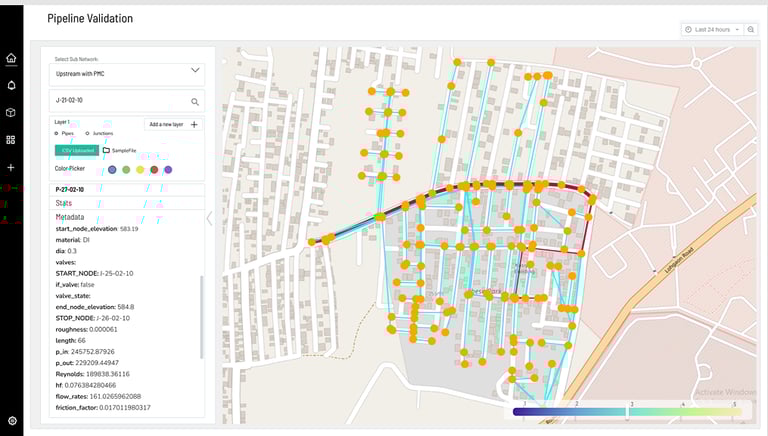
Utility engineers validate hydraulic models using large datasets, but the data lived in spreadsheets while pipelines lived on maps. This disconnect made validation slow and leak detection difficult.
I designed IntelliFlux’s first Pipeline Validation and Leak Detection system from the ground up, evolving later it into a map-first, spatial decision-support tool.
Design Direction
User research showed that engineers reason spatially.
They needed to see where changes occurred and how they propagated through the network. This led to a clear principle:
the map would be the primary interface, not a secondary view.
So I adapted it into:
Map-First System
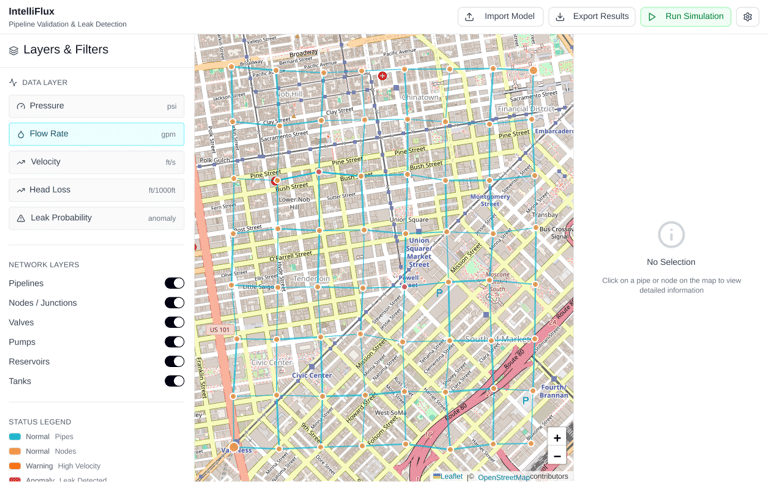
The core experience centers on an interactive map displaying pipelines, nodes, and junctions. Hydraulic metrics such as pressure, flow, and velocity are encoded directly on the network, with directional cues showing upstream and downstream flow.
This allows engineers to understand system behavior at a glance, without translating tables into mental maps.
Managing Complexity
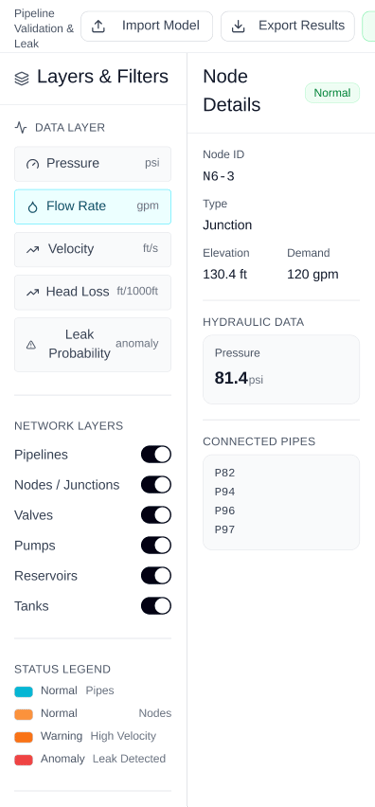
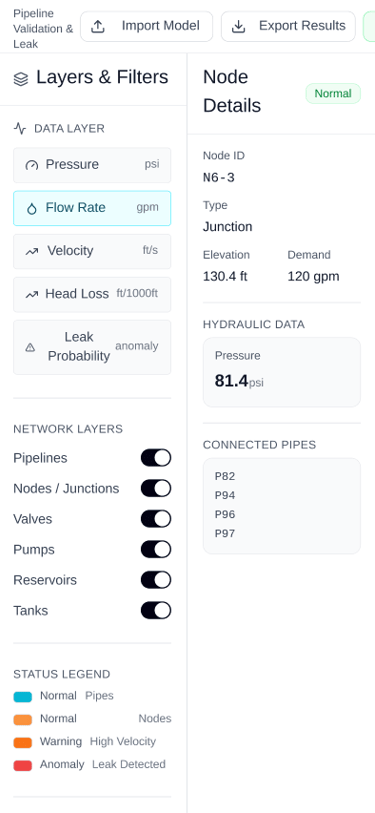
Layer and filter controls let users reveal data based on task and intent. Defaults keep the interface readable, while deeper controls remain accessible when needed.
Complexity is managed through progressive disclosure, not removed.
Visual Leak Detection
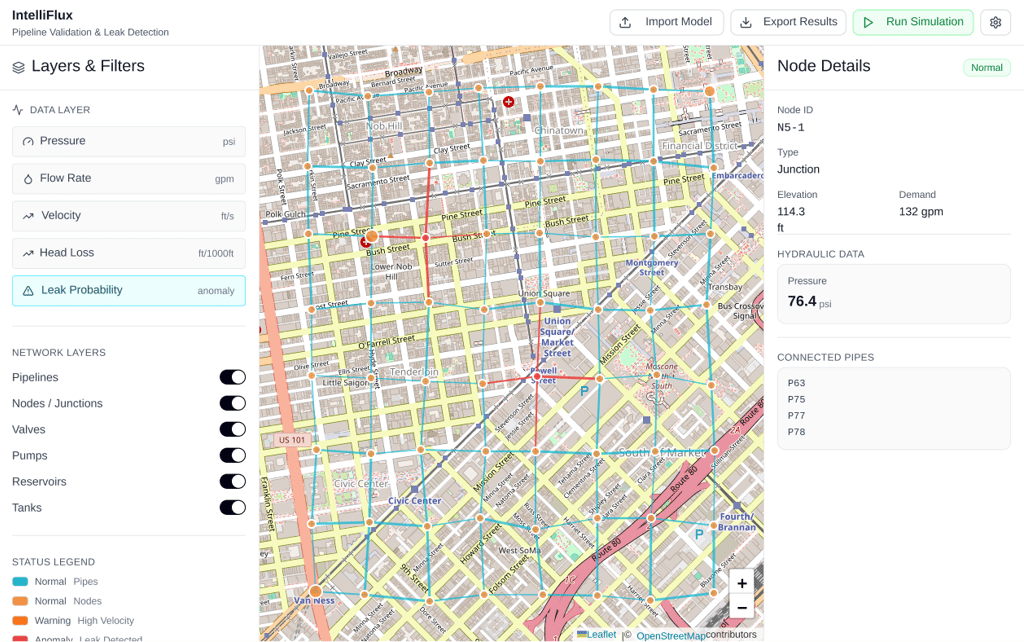
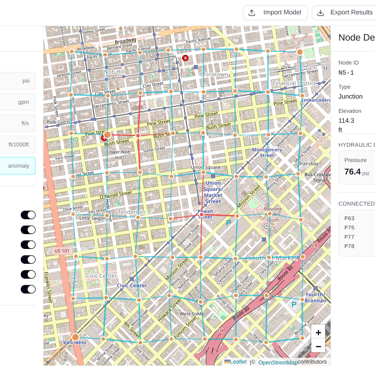
Leak detection was designed as a visual workflow. Engineers can isolate node ranges, highlight abnormal pressure drops, and trace suspicious upstream and downstream segments directly on the map.
This shifts validation from manual comparison to spatial investigation.
Contextual Metadata
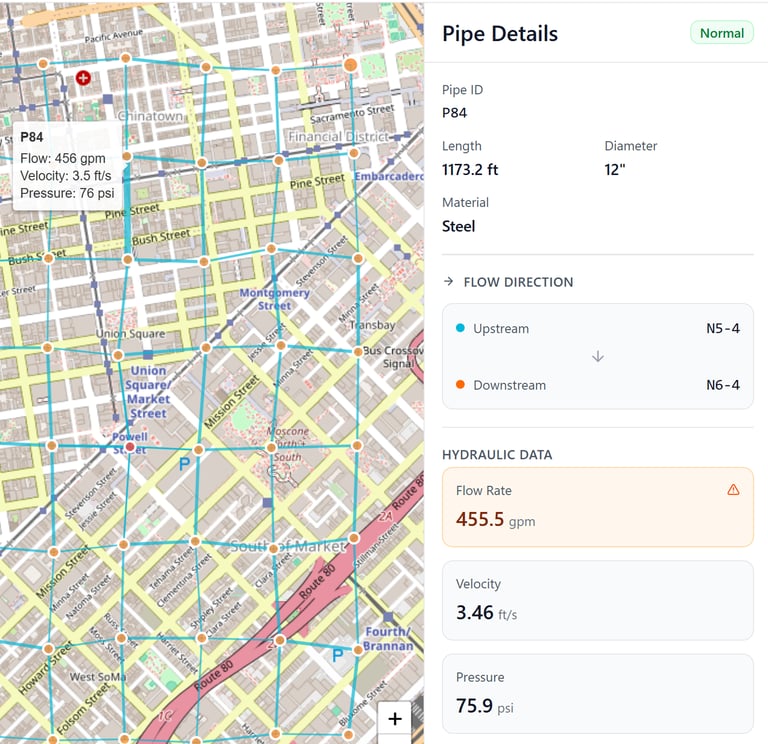
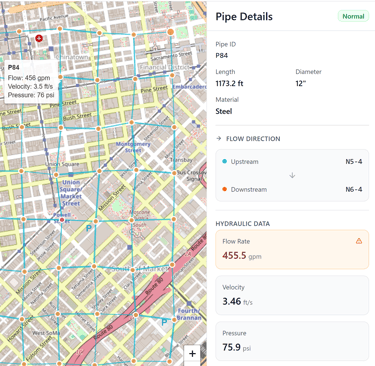
Selecting an asset reveals contextual details such as connected nodes, simulation values, and status indicators. Technical data is grouped clearly and highlighted only when relevant.
Outcome
The system reduced validation time from days to hours and improved confidence in identifying potential leak locations. It positioned IntelliFlux as a decision-support platform, not just a monitoring tool.
This project demonstrates my ability to design complex, data-heavy systems by aligning UX with expert mental models and real operational workflows.
Earlier Version:
I also presented the earlier design version of the Leak Detection tool in my Product Case Portfolio. To explore the first version and read the whole process, click on the button below.